
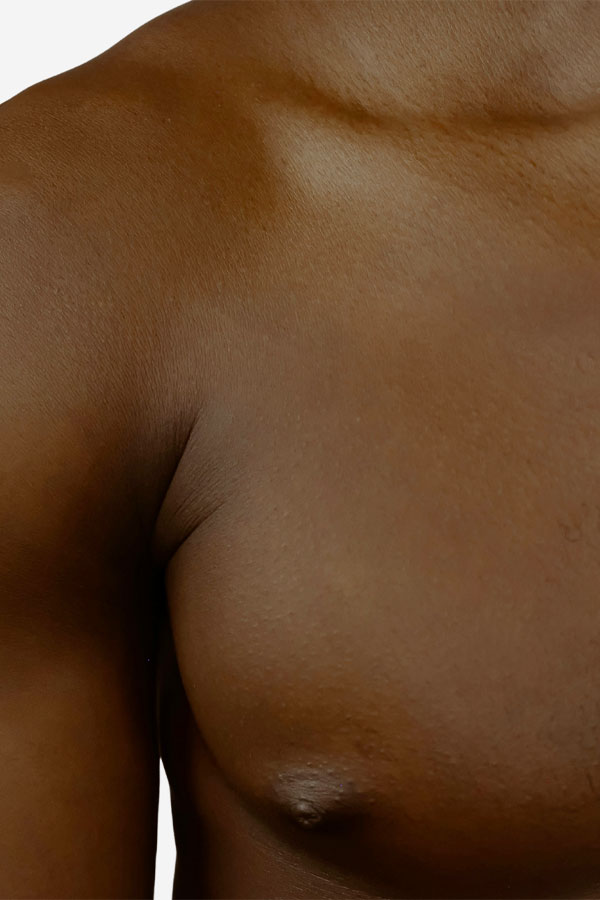
Gynecomastia surgery in Berlin starting at €3,800
For a masculine chest
Gynecomastia surgery is an effective solution for men who suffer from enlarged breast tissue. The procedure involves removing excess glandular tissue and fat to achieve a flatter, more masculine chest contour.
The result: increased self-confidence and improved body contours.
At Innerform in Berlin, we treat gynecomastia using a variety of methods, which are selected on an individual basis depending on the patient’s specific condition.
Table of Contents
- Benefits of gynecomastia surgery at Innerform in Berlin
- Who is a good candidate for gynecomastia surgery?
- What is gynecomastia?
- The gynecomastia surgery procedure
- Gynecomastia Surgery in Berlin: Costs
- Breast Reduction for Men: Methods of Gynecomastia Surgery
- FAQ: Frequently Asked Questions About Gynecomastia Surgery in Berlin
Duration of treatment
Anesthesia
Lasts
Downtime
Type of treatment
Hospitalization
Price
Benefits of gynecomastia surgery at Innerform in Berlin
Liposuction, removal of glandular tissue, or a combination of both
for a natural, firm décolletage
even when there is asymmetry
personalized treatment plan
What our patients say about us



Who is a good candidate for gynecomastia surgery?
The procedure is particularly beneficial for men who have not seen any improvement in the shape of their chest despite exercising and eating a healthy diet. After the procedure, the chest appears firmer and more masculine, which enhances the overall body image.
What is gynecomastia?
Gynecomastia is a condition in which male breast tissue becomes enlarged. This can result in a breast appearance that resembles that of a woman, also known as “man boobs.” The change can occur on one side or both sides and, unlike “false” gynecomastia (pseudogynecomastia/lipomastia), which is caused by excess fatty tissue, requires treatment.
Possible causes of gynecomastia
- genetic predisposition
- hormonal imbalance
- Overweight
- Medications (e.g., anabolic steroids and estrogen-containing medications)
- Diseases (e.g., cancer and liver dysfunction)
- Lifestyle (e.g., heavy drinking)
Treating Gynecomastia: What Are the Options?
Gynecomastia is typically treated surgically, especially if the condition is more severe or if no medical cause can be identified that can be treated by other means.
Surgical treatment is usually performed under general anesthesia and involves two main methods:
- Liposuction for Pseudogynecomastia
- Tissue removal for gynecomastia
Depending on the findings, a combination of treatments may also be possible. In cases of more severe findings, a breast lift may also be indicated.
The gynecomastia surgery procedure
1. Consultation & Preparation
Before treatment, our board-certified plastic surgeons will discuss all available methods and their risks with you. Preparation includes a medical history review, blood tests, and, if necessary, an endocrinological evaluation.
Although true gynecomastia can often be detected by palpation, an ultrasound examination is usually performed as well. This allows us to determine with certainty whether the enlargement is due to enlarged glandular tissue or increased fatty tissue (pseudo-gynecomastia).
We also provide recommendations and guidance on how to prepare for gynecomastia surgery.
In some cases, a mammogram (X-ray) is also recommended to rule out the possibility of breast cancer. However, breast cancer is very rare in men.
2. The day of the operation
On the day of the procedure, depending on the findings and the method used, the procedure is performed either under local anesthesia or general anesthesia.
The procedure usually takes one to two hours, so patients can typically leave the clinic the same day. For more extensive surgeries, we recommend staying overnight at the clinic.
3. Aftercare & Healing
After the surgery, you may experience swelling, bruising, and a feeling of pressure, which will subside or lessen over the course of several weeks. Patients can usually resume their normal daily activities after about a week, though strenuous physical activities should be avoided for 4 to 6 weeks.
A compression garment should also be worn during the healing process. This supports the skin and helps maintain its shape.
In addition, it may take several months for the scars to fully heal. It is important to take good care of the scars to promote healing:
Will scars remain visible after gynecomastia surgery?
Since the procedure involves only small incisions, the scars are often barely visible once they have healed. The surgeon also strategically places the incisions in inconspicuous areas, such as around the nipple or in the armpit, to ensure that the scars are as inconspicuous as possible. It also helps to protect the scars from sun exposure for 6 months.

Gynecomastia Surgery in Berlin: Costs
The cost of gynecomastia surgery in Berlin varies from case to case. In addition to the clinic or practice itself, the following factors primarily influence the cost:
- Treatment method: Liposuction , removal of glandular tissue, breast lift, or a combination
- Type of anesthesia: Local or general
- Extent of the procedure: volume to be removed, on one side or both sides?
Some providers also charge separately for materials and follow-up appointments. At Innerform, however, all essential services are included in the cost of gynecomastia surgery.
Services Included in Gynecomastia Surgery
- Anesthesia
- necessary preliminary examinations (e.g., blood count and ultrasound)
- Overnight stay(s)
- Compression shirt
- medicines
- Follow-up cost insurance
- Aftercare
- The attending physician is available 24/7 during the first 3 days
Starting at €3,800
Our specialists will be happy to advise you on the appropriate options and, following a personal consultation, provide a realistic estimate of the cost of the procedure in your specific case.
Breast Reduction for Men: Methods of Gynecomastia Surgery
Liposuction with VASERlipo®
This procedure involves removing excess fatty tissue that accumulates under the skin of the breast. The surgeon uses a thin cannula, which is inserted into the affected areas.
This method is particularly effective for pseudogynecomastia, which is primarily caused by fat deposits, and may be sufficient for mild to moderate cases.
Learn more about liposuction »
Removal of glandular tissue
In cases of true gynecomastia, where the enlarged breast tissue is due to increased glandular growth, tissue removal is often necessary in combination with liposuction.
During the procedure, excess breast tissue—which is responsible for the breast’s volume—is removed. This is done through an incision at the edge of the nipple or in the armpit to minimize scarring. In some cases, the surgeon may also adjust the areola to achieve the most harmonious and natural-looking result possible.
Breast lift
Depending on the degree of sagging in the breast area, a breast lift may also be an option. This can be the case, for example, after significant weight loss, in cases of pronounced gynecomastia, or generally when the tissue is weak and consequently sagging.
In this procedure, excess skin is removed under general anesthesia, along with connective and/or fatty tissue. In cases of severe sagging, the nipple can also be repositioned to a more natural location. To do this, the surgeon typically makes incisions around the nipple and vertically downward or along the inframammary fold.

Book a Consultation with Us Now
Your satisfaction is our goal
Gynecomastia Surgery in Berlin:
Get a consultation now!
FAQ: Frequently Asked Questions About Gynecomastia Surgery in Berlin
Below, we have answered the most frequently asked questions about gynecomastia surgery.